
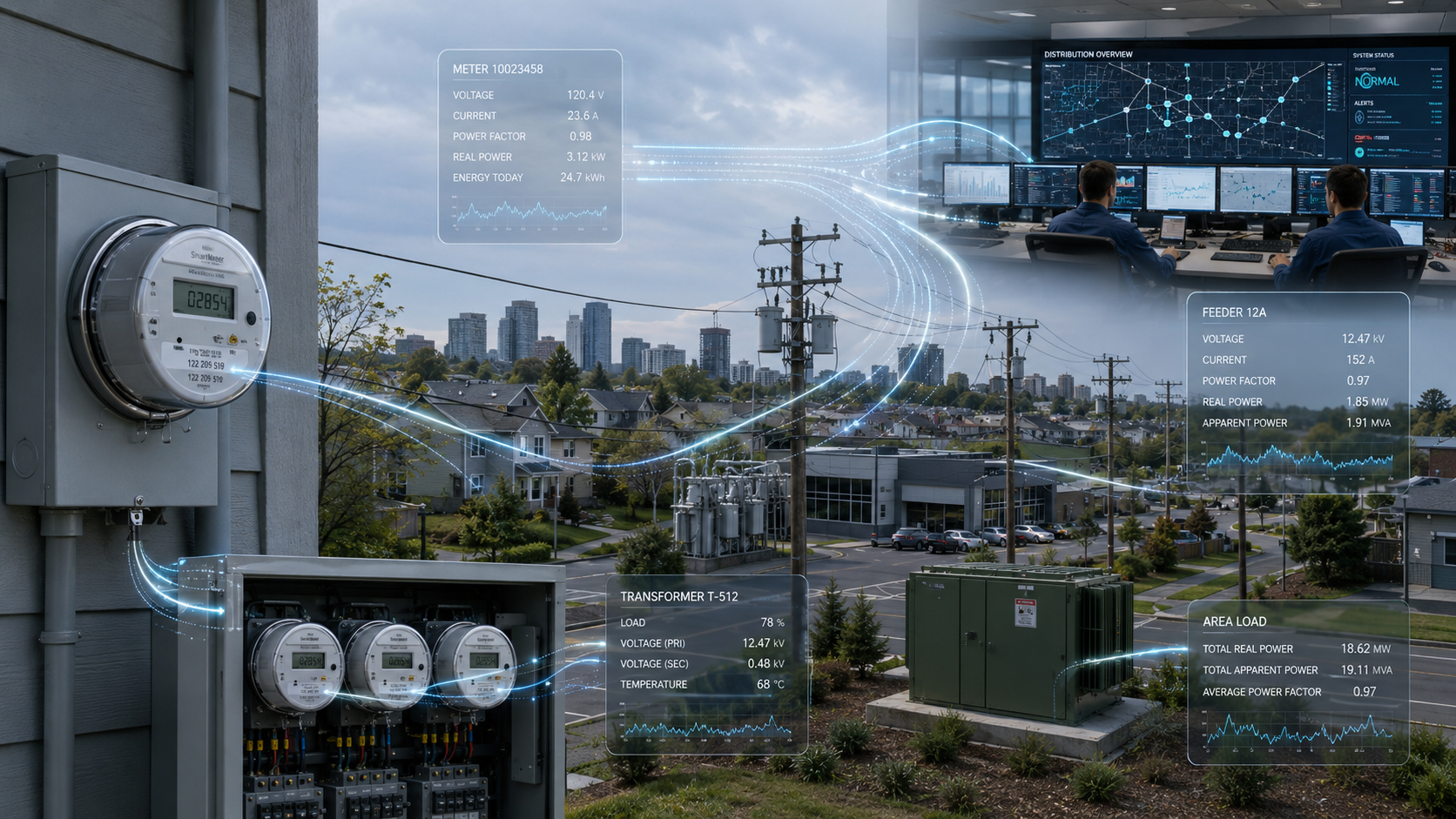
The value of smart meter data now goes far beyond energy consumption records. Distribution networks are entering a new stage that relies more heavily on high-frequency data, real-time analytics, and coordinated decision-making, with smart meters serving as one of the key entry points into this transition.
In their review paper, Nameer Al Khafaf and co-authors note that the widespread deployment of smart meters and advanced sensing technologies is giving distribution network operators access to high-resolution data for real-time monitoring, forecasting, and control. These analytical capabilities are becoming a core part of modern distribution network operations.
1. Smart Meter Data Supports Operational Visibility
The paper first makes it clear that smart meter data is not a single layer of consumption data, but a combination of multiple data types. The most fundamental is temporal consumption data, which records active energy, reactive energy, and consumption at regular intervals. This type of data reflects load patterns shaped by user activity, equipment operation, and environmental conditions, making it a core input for demand forecasting and load analysis.
The paper also points out that different sampling frequencies support different types of analysis: higher-frequency data is more useful for identifying short-term fluctuations and equipment signatures, while lower-frequency data is better suited to long-term modelling and planning.
Building on this, the authors further explain that smart meters can also provide electrical parameter measurements such as voltage, current, frequency, and power factor. These measurements expand operational visibility by showing the physical behaviour of local networks, not just changes in end-use consumption.
For example, voltage deviations may indicate local congestion, transformer tap setting issues, or stress caused by distributed energy resource integration. Current waveforms and harmonic information may also help reveal abnormal equipment behaviour or the presence of non-linear loads.
Taken together, the paper’s position is clear: smart meter data serves as a foundation for data-driven intelligence in modern distribution networks.
2. Digital Twins Strengthen Prediction and Coordination
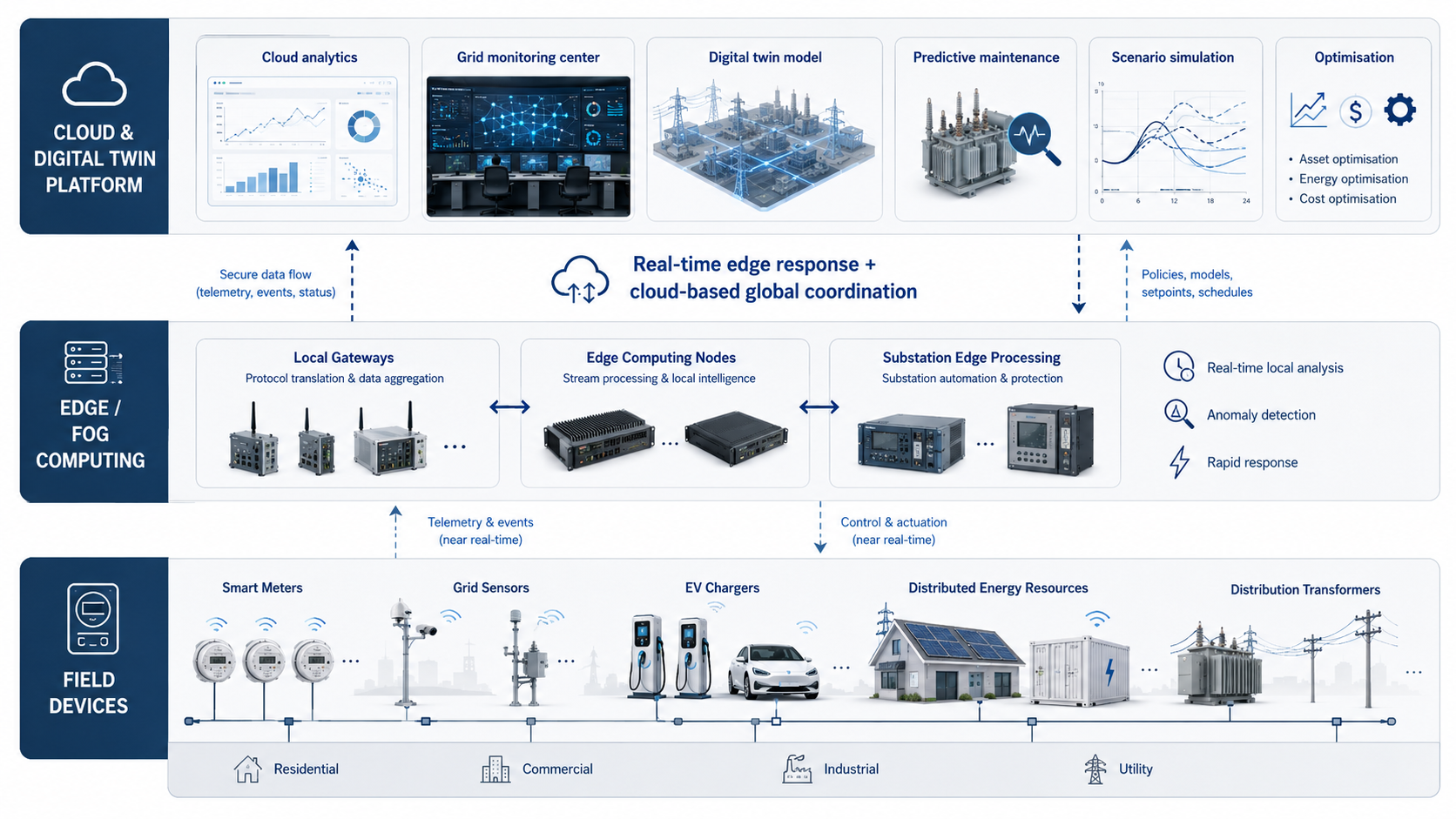
The paper describes digital twins as dynamic virtual replicas of physical grid infrastructure that allow distribution network operators to simulate, monitor, and optimise system performance in near real time. In practice, this makes the digital twin a continuously updated operational support platform.
It integrates data from smart meters, weather systems, and operational devices into a unified model that can simulate how grid components behave under different conditions.
This creates several practical capabilities:
- Digital twins support predictive maintenance by helping identify equipment degradation before faults occur.
- They support adaptive control strategies by enabling operating decisions to be adjusted under changing conditions.
- They support scenario planning by allowing operators to assess the impact of distributed energy integration, energy storage dispatch, or load changes before action is taken in the field.
According to the paper, these capabilities can improve reliability, reduce operating costs, and enhance grid flexibility. In that sense, the role of the digital twin is to convert field data into stronger predictive and coordination capability.
The authors also make an important point: the value of digital twins depends on more than modelling alone. The management of multi-source data, real-time processing capability, and continuous alignment between the model and actual system conditions all directly affect their effectiveness.
The paper ultimately argues that digital twins can help bridge the gap between real-world operations and advanced analytics, provide stronger situational awareness and greater operational flexibility, and become an important cornerstone of network intelligence.
3. Fog Computing Supports Real-Time Decisions at the Edge
Modern distribution networks continuously generate large volumes of data from smart meters, sensors, EV charging infrastructure, and DER-connected devices. In many operating scenarios, such as load imbalance, equipment failure, or voltage anomalies, the system needs to detect and respond quickly.
In this context, traditional cloud computing remains useful for storage, historical analysis, and visualisation, but it is often constrained by latency, bandwidth use, and centralised security risks. Fog computing has emerged as a way to address these limitations.
Fog computing moves processing resources closer to the data source, including smart meters, gateways, and local substations. This allows some analytical tasks to be handled directly at the edge rather than being sent back to a central platform first.
The paper gives practical examples such as local outage detection and EV charging coordination, both of which can benefit from faster response and reduced communication overhead when handled closer to the field. It also notes that tasks such as anomaly detection and topology identification benefit significantly from low-latency analytics.
In emergency conditions or when network connectivity is limited, local decision-making capability can also improve system resilience.
Importantly, the paper does not position fog computing as a replacement for the cloud. Instead, it describes a layered control structure in which initial processing takes place at the edge, while aggregated results are sent to the cloud for longer-term optimisation and planning.
This creates a coordinated architecture that combines edge-level real-time response with cloud-level system-wide oversight. The paper therefore presents fog computing as a foundational enabler of real-time network intelligence, supporting immediate operational needs while preserving a broader perspective for data-driven grid management.
Source: Adapted from Smart meter data intelligence for sustainable distribution network operations: State-of-the-Art applications and pathways toward net-zero (Renewable and Sustainable Energy Reviews, 2026), published under CC BY 4.0.
