
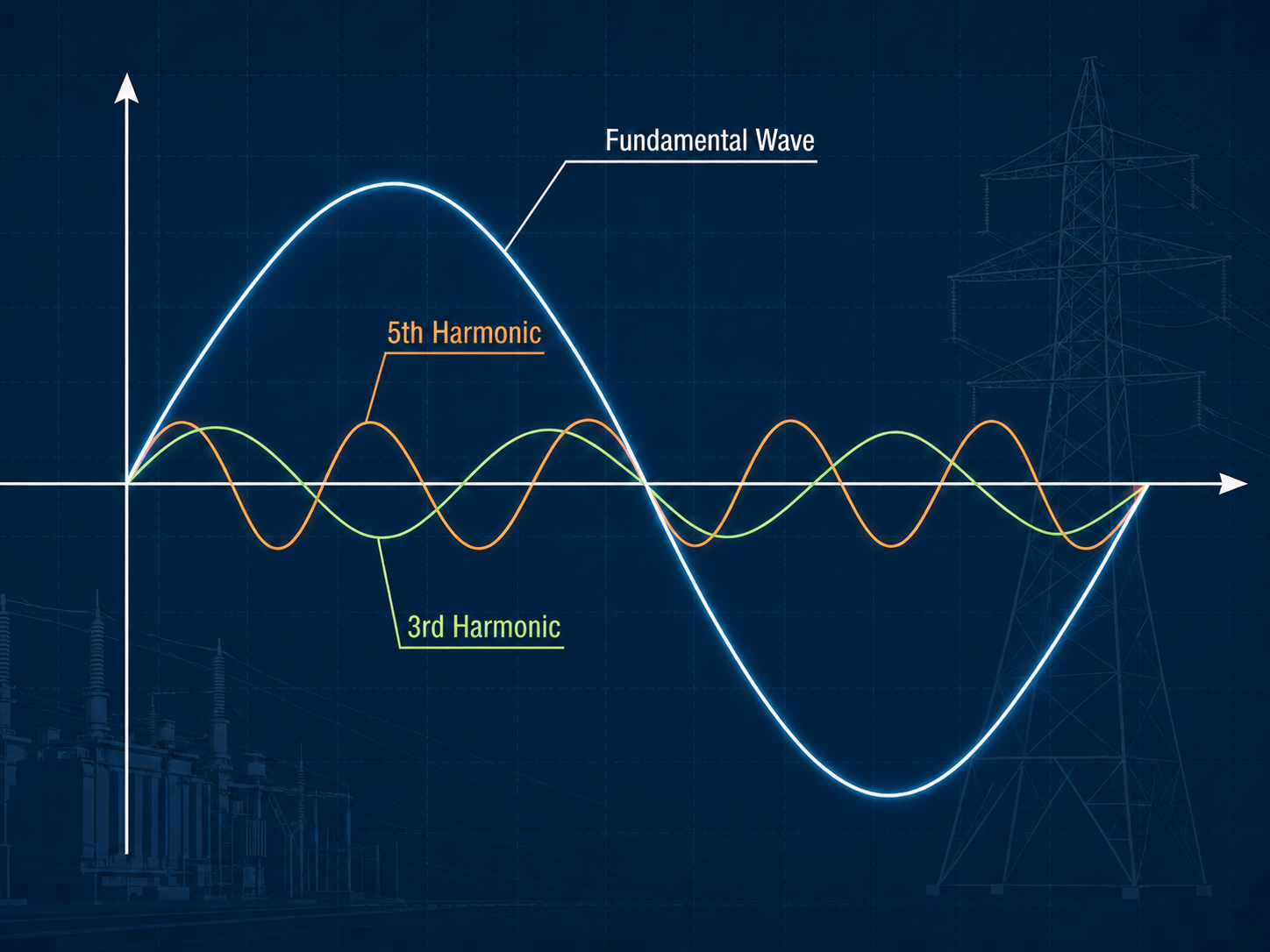
Under ideal conditions, the voltage and current waveforms in a power system should remain close to stable sine waves. Once additional components with frequencies that are integer multiples of the fundamental frequency appear in the system, waveform distortion occurs. These additional components are known as harmonics.
In a 50 Hz grid, for example, 150 Hz is the 3rd harmonic, 250 Hz is the 5th harmonic, and so on. Harmonics are a power quality issue, which is why related standards have long set limits on harmonic levels in public power networks and on harmonic current injection from equipment.
What Are Harmonics?
Harmonics can be understood as higher-frequency components superimposed on an ideal sine wave. From the perspective of waveform analysis, any non-sinusoidal periodic waveform can be broken down into a fundamental component and a series of harmonic components whose frequencies are integer multiples of the fundamental.
For this reason, harmonic problems are essentially waveform distortion problems. The concept may sound abstract, but in practical engineering work it usually means that the conditions for measuring voltage, current, or power become more complicated, and the operating status of the system becomes harder to assess from the perspective of the fundamental wave alone.
What Causes Harmonics?
The most common source of harmonics is non-linear loads. The current drawn by this type of equipment no longer follows the voltage in an ideal sinusoidal shape, and harmonic currents are therefore injected into the system.
Typical examples include:
- Rectifiers
- Variable frequency drives
- Switched-mode power supplies
- Computer and control centre loads
- Laboratory electronic equipment
- End-use devices with power electronic interfaces
In addition to end-user equipment, some non-linear components in transmission and distribution systems also contribute to harmonic formation. In other words, harmonics do not come from just one special type of device. They are directly related to the growing use of power-electronic loads in modern power systems.
Looking one step further, harmonic currents can be converted into voltage distortion through system impedance. As a result, the same non-linear load may produce different levels of voltage distortion when connected to different systems. This is also why harmonic problems cannot be judged by looking at a single piece of equipment alone. System structure, impedance conditions, and grid connection environment all need to be taken into account.
What Are the Risks of Harmonics?
The first major impact of harmonics is additional loss and heat. In real systems, harmonics increase extra losses in conductors, cables, transformers, and motors, which in turn leads to temperature rise.
One typical phenomenon repeatedly seen in engineering cases and technical training materials is that the heating level of equipment does not always match its apparent kVA loading. The real cause often lies in the additional losses created by harmonic currents.
The second major impact is malfunction and operating abnormalities. In a harmonic environment, sensitive equipment, protection devices, and circuit breakers may experience nuisance tripping, false operation, or other problems that are difficult to explain.
In distribution systems, these issues can sometimes be harder to identify than simple overheating, because they often appear as occasional equipment abnormality or unstable control system behaviour, rather than visible physical damage.
The third major impact is degraded measurement conditions. When high-frequency harmonics are present, voltage, current, and power readings become more sensitive to the bandwidth of the measuring instrument and to the impedance of the supply circuit.
This means harmonics affect not only equipment operation, but also measurement itself. For electricity meter testing, error analysis, and on-site assessment, this deserves particular attention, because the same test method may need to be interpreted differently under ideal sinusoidal conditions and under actual harmonic conditions.
Sources
- Quality of Electric Energy Supply — Harmonics in Public Supply Network (GB/T 14549-1993), Standardization Administration of China.
- IEC 61000-4-7: Testing and Measurement Techniques – General Guide on Harmonics and Interharmonics Measurements and Instrumentation, International Electrotechnical Commission.
- NIST power quality documentation and university technical materials on harmonic sources, waveform distortion, and system impacts.
