
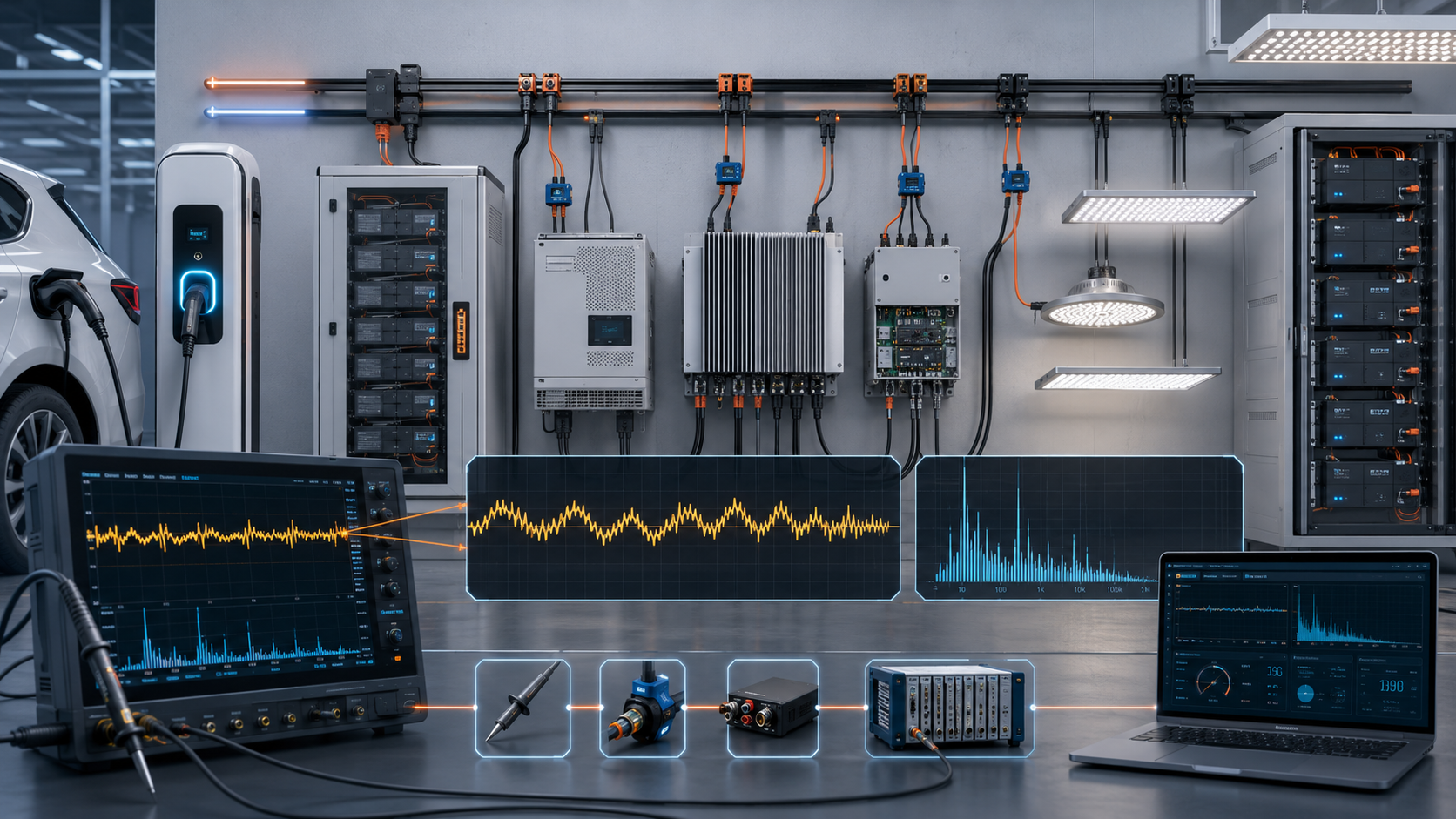
As renewable energy sources, storage units, LED lighting, and electric vehicles continue to expand, low-voltage DC grids are receiving more attention as a way to reduce conversion losses and simplify local power management.
At the same time, reliable DC operation depends on a better understanding of distortions around the DC bus, including ripple and other frequency components created by power converters, source instability, and changing loads. These conditions are pushing DC power quality measurement into a much more important role.
Why DC Metering Is Facing New Pressure
The challenge in DC systems goes beyond reading a steady DC value. Metering and measurement now need to account for the dynamic behavior of LVDC grids, the lack of clear EMC limits, and the need for accurate power and energy measurement for billing purposes.
This becomes even more relevant because most electricity meters are still designed on the basis of AC standards, while DC applications are increasing in real networks.
Traditional AC Measurement Logic Has Limits in DC Systems
DC disturbances do not follow the same measurement logic as traditional AC power quality phenomena. In AC systems, standardized analysis methods often rely on synchronization with the 50 Hz or 60 Hz fundamental frequency.
In DC systems, the measured frequencies are not controlled in the same way and are not synchronized with 50 Hz. This makes direct use of conventional AC methods less reliable, because it can introduce spectral leakage and produce a spectrum that does not fully represent the original signal.
The measurement challenge is also technical. A measurement chain must capture a large DC component and much smaller distortion components at the same time.
The paper identifies several practical trade-offs here:
- Acquisition systems must balance resolution and bandwidth
- Sensor selection must balance linearity and frequency response
- Data processing methods directly affect result accuracy
As a result, the quality of the measurement chain and the choice of data processing method both have a direct effect on result accuracy.
Standards and Definitions Are Still Developing
Standardization for DC power quality is still at an early stage, but the groundwork is being built. Research reviewed in the paper identifies voltage ripple, DC distortions, and voltage dips and swells as critical LVDC power quality disturbances.
At the international level, IEC has already established the System Committee on LVDC and released IEC TR 63282:2024, which defines nominal LVDC voltage levels and proposes preliminary requirements for DC power quality.
The report describes DC distortions as multifrequency AC components superimposed on DC voltage and current and recommends characterizing them through spectral decomposition.
This means the industry is still building the foundation for DC metrology:
- How to define disturbances
- How to classify them
- How to measure them
- How to interpret them consistently in future applications
The paper also notes that the joint European metrology project “20NRM03 DC Grids” was launched specifically to establish traceable measurement systems for DC power quality parameters and support future standardization.
The Measurement Setup Itself Can Distort the Result
One of the paper’s most practical findings is that the measurement setup itself can interfere with the result.
Data from previous measurement campaigns showed that electromagnetic radiation from power supplies, cables, or probes can appear in the measured spectrum and be mistaken for actual DC disturbances in the network.
The paper gives an example of a 58.8 kHz component that appeared in measured voltage spectra across all tested grid configurations and was later attributed to the voltage probe or measurement system power supply rather than to the actual grid.
The paper also reports that low-amplitude disturbances can be masked by the noise of the acquisition system, especially when measurement ranges are set high.
Because clear EMC emission limits for DC domains are still lacking, choosing a low-noise measurement chain becomes especially important when identifying small distortion amplitudes.
In practice, this means that DC metrology depends not only on what is happening in the grid, but also on how well the measurement chain is understood and controlled.
Laboratory Accuracy and Field Flexibility Both Matter
The study develops two complementary traceable measurement chains to address this reality.
One is optimized for laboratory use and prioritizes low uncertainty in controlled conditions. The other is designed for field work and prioritizes flexibility, portability, and robustness in less controlled environments.
This dual approach reflects a practical point for the industry: DC measurement needs both laboratory-grade accuracy and field-ready usability.
According to the paper, both arrangements are intended to measure:
- Voltages up to 1000 V
- Currents up to 30 A
- Frequency components up to 150–500 kHz
- Uncertainty ranging from 0.01% to less than 1%
The paper also concludes that the laboratory chain generally achieves lower uncertainty, while the field chain accepts higher uncertainty in exchange for better flexibility.
What This Means for Future Meter Testing
For meter testing and metrology, the message is clear. Future DC applications will require more than steady-state DC measurement.
They will require the ability to identify ripple, distortions, and higher-frequency components in a way that is traceable, repeatable, and meaningful in both laboratory and field environments.
As LVDC, EV-related applications, and converter-based systems continue to grow, DC power quality measurement is becoming a practical metering issue rather than a purely academic one.
Source Note
Adapted from “Exploring DC Power Quality Measurement and Characterization Techniques” by Daaboul et al., Sensors 2025, 25, 6043, published under CC BY 4.0. Edited for industry interpretation.
