
With the development of smart grids, smart electricity meters are being applied more and more widely. Smart electricity meters have become an important foundation for advancing the intelligent development of power systems. As the number of meters in operation continues to grow and their deployment becomes more dispersed, relying solely on removing meters and sending them back to the laboratory will clearly increase both time and labour costs. At the same time, industry research has also shown that real operating conditions often differ from ideal laboratory conditions. This is especially true when field load conditions and power quality are more complex, meaning that off-site calibration results may not fully reflect the error performance of meters under actual operating conditions. For this reason, on-site calibration is receiving increasing attention.
Off-Site Calibration Is Facing Pressure from Efficiency and Application Scenarios
The traditional process is usually to take the meter out of service and send it back to the laboratory for error calibration. This approach has its mature side, but under the background of large-scale smart meter deployment, meter removal, transportation, reinstallation, and centralised verification all create additional workload. In some application scenarios, the large number of smart meters and their wide coverage make one-by-one handling and one-by-one calibration increasingly difficult. For meters in operation, field conditions themselves can also affect error performance, so sending meters back to the laboratory for testing does not always fully cover actual application scenarios.
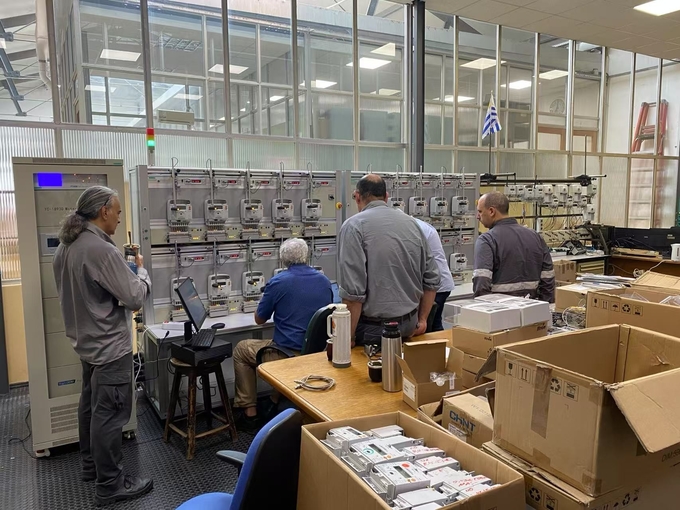
On-Site Calibration Is Focusing on Both Field Adaptability and Scalability
On-site work is not simply a matter of moving the test location from the laboratory to the user side. As harmonic distortion and non-ideal waveforms in low-voltage distribution systems become more common, electricity meter testing and calibration increasingly need to take real operating conditions into account, rather than only performance under ideal sinusoidal conditions. Around this issue, industry discussion is gradually expanding toward several more practical questions: whether the measurement chain remains stable under field conditions, whether frequency fluctuations and power quality changes will affect results, and how to balance usability and accuracy in on-site applications.
As the number of devices in operation continues to rise, the industry’s focus is also changing. One direction is to strengthen on-site capability, so that high-accuracy testing and reference capability can be extended more effectively to field applications. Another direction is to explore online or remote calibration methods in order to improve scalability and operational efficiency in large-scale scenarios. Existing studies describe online calibration as a new method for estimating error by analysing meter data, and other studies clearly identify scalability and operational efficiency as the goals of remote calibration. Electricity meter testing is moving away from a single laboratory-centred approach toward one that places greater emphasis on balancing field adaptability, efficiency, and accuracy.
On-Site Capability Is Becoming a More Practical Testing Requirement
For utility metering departments, metrology laboratories, and field technical teams responsible for electricity meter testing, calibration, and on-site verification, the focus of meter testing is increasingly on whether calibration instruments are suitable for field work, whether they can cover more complex operating conditions, and whether they can strike a balance between efficiency and accuracy. This is also why testing workflows and portable test equipment with on-site application capability are becoming more practically relevant.
Source Note
This article is adapted for industry interpretation from publicly available research, including Design of On-Site Calibration Device for Electricity Meter Based on Pulse Detection (Inventions, 2025), relevant IMEKO papers on on-site calibration and non-sinusoidal calibration conditions, Acta IMEKO papers on online and remote calibration, and a 2025 Applied Sciences paper on synchronous remote calibration.
The Inventions paper is published under the Creative Commons Attribution 4.0 International License (CC BY 4.0).
